




In the modern feed processing industry, equipment selection is no longer a simple comparison of specifications. It has become a structured decision-making process that directly impacts production stability, product quality, and long-term profitability.
Feed plants today face a wide range of extrusion technologies, each designed for different applications, raw materials, and output requirements. Choosing the wrong system can lead to inefficiency, unstable production, or even financial losses.
Understanding how to evaluate and compare different extrusion systems is therefore essential for both new investors and established manufacturers planning upgrades.
Why Equipment Selection Has Become More Complex
A decade ago, extrusion equipment selection was relatively straightforward. Most producers focused on a limited product range and operated under stable market conditions.
Today, the situation is different.
Raw materials vary widely in quality and composition. Customer demand shifts rapidly. Product diversity is increasing across aquaculture, pet food, and livestock nutrition sectors.
This complexity requires more advanced decision-making.
Instead of focusing only on capacity or price, manufacturers now evaluate flexibility, energy efficiency, automation level, and long-term scalability.
The Role of Single-Screw Systems in Entry-Level Production
For many small and medium-sized feed mills, simplicity remains a key advantage.
A single screw extrusion machine is often the first choice for businesses entering the market due to its operational stability and relatively low investment threshold.
It performs particularly well in:
- Standard livestock feed production.
- Basic floating fish feed processing.
- Simple grain expansion applications.
Its straightforward design allows operators to maintain consistent output without extensive technical training.
However, while single-screw systems are effective for stable formulations, they may face limitations when processing highly complex or variable raw materials.
When Production Demands Exceed Basic Systems
As businesses grow, production requirements inevitably evolve.
Companies often begin introducing more diversified product lines, including shrimp feed, pet nutrition products, and specialty aquatic diets.
At this stage, flexibility becomes a critical factor.
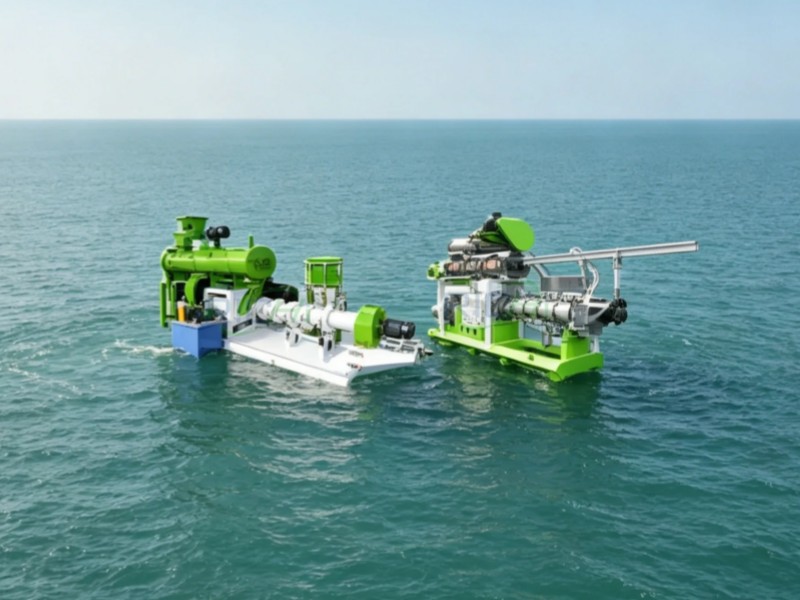
To meet these demands, many producers upgrade to advanced configurations such as a 0.5-12 T/H twin screw extruder for sale, which provides improved mixing capability and better control over processing conditions.
These systems are designed to handle:
- High-moisture formulations.
- Complex ingredient combinations.
- Sensitive nutritional recipes.
- Variable raw material quality.
The result is greater consistency and broader product adaptability.
Understanding Capacity vs. Stability Trade-Offs
One of the most common misconceptions in equipment selection is assuming that higher capacity automatically leads to better performance.
In reality, extrusion systems must balance capacity with stability.
A high-output system that produces inconsistent product quality may ultimately reduce profitability due to waste, reprocessing, and customer dissatisfaction.
On the other hand, a well-balanced system with moderate output but stable performance often delivers superior long-term returns.
Manufacturers must carefully evaluate:
- Daily production targets.
- Product consistency requirements.
- Maintenance intervals.
- Operator skill levels.
These factors often matter more than theoretical maximum output.
(Related Post: https://www.richipelletmill.com/floating-fish-feed-extruder-machine/ )
Comparing Equipment Configurations in Real Applications
In practical production environments, different extrusion systems serve different roles.
A single screw extruder for sale may be ideal for standardized production lines where recipes remain consistent over time.
Meanwhile, twin-screw systems are better suited for:
- Multi-formula production.
- Premium pet food manufacturing.
- Research and development facilities.
- High-precision aquatic feed production.
This division of roles allows manufacturers to optimize investment based on actual production needs rather than theoretical capabilities.
The Importance of Supplier Capability
Equipment performance is not determined by machinery alone.
Supplier expertise plays a crucial role in system performance, installation quality, and long-term reliability.
Experienced manufacturers such as Richi Pellet Mill provide more than just equipment—they offer system design support, installation guidance, and operational training.
This integrated approach reduces risk and improves project success rates.
Key supplier services include:
- Production line design.
- Raw material testing.
- Operator training programs.
- After-sales technical support.
- System optimization recommendations.
Choosing a capable supplier often has a greater impact on long-term success than choosing between machine models.
Common Mistakes in Equipment Selection
Many feed plant owners encounter similar challenges when selecting extrusion systems.
1. Overestimating initial demand
Investing in oversized equipment too early can lead to low utilization rates.
2. Ignoring product expansion plans
Some systems cannot adapt to future product diversification.
3. Focusing only on purchase price
Lower upfront cost may result in higher long-term operational expenses.
4. Underestimating maintenance requirements
Complex systems require proper technical support and trained operators.
5. Neglecting raw material variability
Different ingredients affect extrusion performance significantly.
Avoiding these mistakes improves both operational efficiency and investment returns.
Why Flexibility Is Becoming the Key Advantage
Modern feed markets are unpredictable.
Prices fluctuate, demand changes, and new product categories emerge frequently.
In this environment, flexibility becomes more valuable than raw output capacity.
Flexible systems allow manufacturers to:
- Switch between formulations quickly.
- Respond to seasonal demand.
- Introduce new products faster.
- Reduce inventory risk.
- Improve resource utilization.
This adaptability is one of the main reasons many producers invest in advanced systems like an industrial twin screw extrusion machine for sale.
Building a Long-Term Production Strategy
Successful feed producers do not treat equipment as isolated assets.
Instead, they integrate extrusion systems into a broader production strategy that includes:
- Market analysis.
- Product development planning.
- Supply chain management.
- Workforce training.
- Technology upgrades.
This strategic approach ensures that equipment investments support long-term business goals rather than short-term output targets.
Final Thoughts
Choosing between different extrusion systems is not a purely technical decision. It is a business strategy that influences every aspect of feed production.
Single-screw systems provide simplicity and stability for basic applications, while twin-screw systems offer flexibility and advanced processing capabilities for complex production environments.
Companies that align equipment selection with real operational needs are more likely to achieve sustainable growth and profitability.
If you’re evaluating different extrusion options and want to explore practical solutions for your production line, top article provides additional insights into system selection and optimization strategies.


