




Feed is the single largest variable cost in poultry production. For many farms, it represents 70% or more of total operating expenses. That number alone explains why so many poultry farmers eventually ask the same question: should we keep buying commercial feed, or should we make our own?
The answer is not the same for every farm. A farm with a few hundred birds will almost certainly lose money trying to mill its own feed. A farm with several thousand birds may find that on-farm production pays for itself within a year or two. Between those two extremes lies a wide range of operations, each with its own economics, labor situation, and growth plans.
The Scale Question Comes First
The decision to produce feed on-farm depends more on scale than on any other factor. The cost advantage of homemade feed comes from two sources: buying raw materials at better prices and avoiding the brand premium built into commercial feed. Neither advantage exists if the farm is too small to buy ingredients in meaningful volumes or to run the equipment efficiently.
Practical experience from small-scale poultry operations suggests a rough threshold. A farm with fewer than 1,000 birds is usually better off buying commercial feed. The savings from homemade feed are too small to justify the investment, the learning curve, and the management attention required. Once a farm reaches 3,000 to 5,000 birds, the picture changes. At that scale, the annual savings from producing feed on-site can cover the cost of a small feed making system within a reasonable period, and stable savings follow in subsequent years.
For a 10,000-broiler operation, the arithmetic is straightforward. Raising birds from chick to market weight requires roughly 12 tons of feed. Commercial feed at a typical market price might cost around 4,500 yuan per ton, for a total of 54,000 yuan. Buying raw materials like corn and soybean meal directly and milling on-farm might bring the cost down to about 3,200 yuan per ton, or 38,400 yuan. That is a difference of 15,600 yuan per cycle. Over several cycles, the equipment investment pays back quickly.
But these numbers are illustrative, not universal. Feed and raw material prices vary by region and season. The real calculation must use local prices, local labor costs, and local electricity or fuel rates.
What Changes When You Make Feed Yourself
The financial case is only part of the story. On-farm feed production changes how the farm operates in several important ways.
Freshness and control. Commercial feed often contains preservatives and additives to extend shelf life during storage and transport. Feed made on-farm can be used fresh, without those additives. This matters most for farms targeting organic eggs or meat, where synthetic preservatives may not be allowed. It also matters for flocks with specific nutritional needs at different growth stages. A chick requires high-protein, high-energy feed. A laying hen at peak production needs higher calcium. Adjusting the formula on-site allows the farmer to match the feed to the flock’s actual requirements rather than relying on a standard commercial ration.
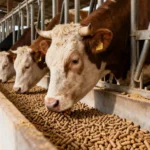
Feed form and waste. Pelleted feed generates far less dust than mash or crumbles. Less dust means fewer respiratory problems in the flock and less feed wasted. Commercial powdered feed can result in waste rates as high as 15%. Properly pelleted feed can bring that down below 5%. On a farm using hundreds of tons of feed per year, that difference is significant.
Management burden. Making feed on-farm adds work. Someone must source ingredients, manage inventory, operate the mill, monitor quality, and maintain equipment. On a farm where labor is already stretched, this can be a real constraint. On a farm with underused labor capacity, it can be an opportunity.
Raw Material Strategy for Small-Scale Production
The cost advantage of on-farm milling depends almost entirely on raw material sourcing. If a farm pays retail prices for small quantities of corn and soybean meal, the savings may disappear. The whole point is to buy ingredients at closer to wholesale prices, in larger volumes, and to use locally available alternatives where they make sense.
A basic poultry feed formulation typically includes an energy source, a protein source, a mineral source, and vitamin or supplement premixes. Maize or wheat provides energy. Soybean meal, oil press cake, or fishmeal provides protein. Limestone or shell powder provides calcium. Salt and mineral premixes fill the gaps.
The exact mix depends on what is available locally and at what cost. In some regions, maize is cheap and abundant. In others, wheat or sorghum may be more economical. Rice bran and wheat bran are common by-products that can partially replace more expensive energy sources. Oilseed cakes, such as soybean cake, sunflower cake, or cottonseed cake, can substitute for part of the protein requirement.
Local and seasonal materials can reduce costs further. Dried cassava peels, for example, have been used as an alternative energy ingredient in poultry feed in some regions. Fermented rice bran can reduce crude fiber and phytic acid levels, improving digestibility. Insect meal, particularly from black soldier fly larvae, is gaining attention as a protein source for small-scale production.
The key is not to chase exotic ingredients. It is to understand what is reliably available, what it costs per unit of nutrient, and how it behaves in the feed mill. A cheap ingredient that produces soft pellets or poor growth is not cheap at all.
Equipment Choices for a 1 T/H Operation
A poultry feed production line rated at 1 ton per hour is a common entry point for farm-scale production. At this capacity, the equipment must be matched to the farm’s actual daily demand, not to an aspirational future target.
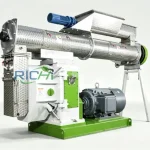
The core of a small line is three machines: a grinder, a mixer, and a pellet mill. A hammer mill reduces raw materials to a consistent particle size. A mixer blends the ingredients uniformly, ensuring that vitamins, minerals, and supplements are distributed evenly. A pellet mill compacts the mixed mash into durable pellets.
For a farm looking at a 1t/h small poultry feed production line for farm use, the equipment should be sized so that one or two workers can operate it comfortably. Power requirements, physical footprint, and maintenance access all matter more at this scale than in a large industrial mill. A line that requires constant attention or frequent breakdowns will quickly become a burden.
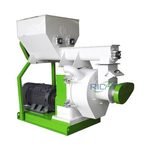
A well-designed 1-ton-per-hour unit integrates crushing, mixing, and pelletizing in a compact layout. The hammer mill handles corn, soybean meal, and other main ingredients with adjustable particle size. The mixer ensures uniform distribution of trace components. The ring-die pellet mill produces pellets with consistent hardness and smooth surfaces, reducing waste and improving digestion. The pellet size can be changed by swapping the ring die, allowing one machine to serve different flock stages or even different poultry species.
The decision to buy a complete integrated unit versus assembling components from different suppliers depends on budget, technical capability, and the level of support available locally. Integrated units simplify installation and commissioning. Component-based systems offer more flexibility but require more engineering input.
When evaluating equipment suppliers, it helps to understand the manufacturer’s background and production history. Some buyers review Richi Manufacture before requesting a project layout or quotation, which can provide useful context about the company’s experience and capabilities. But the evaluation should go beyond a company profile. Ask how the supplier handles installation, commissioning, and operator training. Ask what spare parts are recommended and how quickly they can be delivered. A supplier who asks detailed questions about your farm’s species, scale, and raw materials is usually more serious than one who sends a price list immediately.
For farms exploring equipment categories before making a final decision, https://pelletmakermachine.com/animal-feed-machine/ provides a reference point for the types of machines involved in animal feed production. It is a starting point for deeper technical discussions, not a substitute for them.
Budget Realities and Phased Investment
One of the most common mistakes in small-scale feed milling is spending too much too soon. A farm buys a high-capacity line with full automation, then discovers that the equipment sits idle most of the week because the farm’s actual feed demand does not justify the throughput. The capital is tied up, the maintenance costs continue, and the payback period stretches out indefinitely.
A more practical approach is to start with the essentials and upgrade in phases. For a small farm, a basic three-machine line — grinder, mixer, and pellet mill — covers the core production process. Manual packaging is sufficient at this scale. A simple dust collection bag filter handles basic air quality needs without the expense of a full system.
As the farm grows, upgrades can be added. An automatic batching system improves formula accuracy and reduces labor. A counterflow cooler prevents freshly made pellets from molding during storage. Automatic packaging reduces manual handling. Frequency converters on motors can increase output and reduce energy consumption. Each addition should be justified by a clear operational need, not by the desire to have a complete-looking plant.
The goal is not to build the most impressive feed mill. It is to build the feed mill that matches the farm’s actual production, labor, and financial capacity.
Quality Control Without a Laboratory
A small farm cannot justify a full feed testing laboratory. But that does not mean quality control is impossible. Simple, consistent checks catch most problems before they become serious.
Incoming materials. Check moisture content. High-moisture grain or bran will mold in storage and create flow problems in the mill. Look for signs of pests, mold, or contamination.
Grinding. Check particle size by feel and by sieving a sample. If the grind is too coarse, pellets will be weak. If it is too fine, the mill will consume more energy and may face bridging in the bins.
Mixing. Verify mixing time and uniformity. A simple test involves taking samples from different points in the mixer after discharge and comparing color and texture. Uniformity is especially important for premixes and medications.
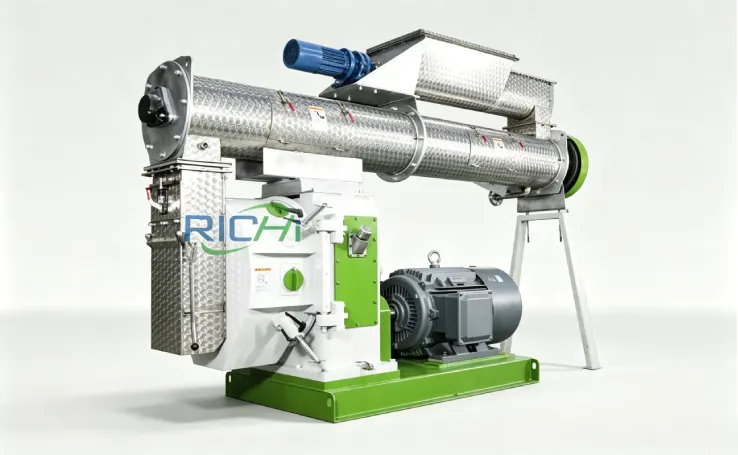
Pelleting. Watch the pellet mill motor load, die temperature, and pellet appearance. Soft, crumbly pellets usually indicate a conditioning problem. Shiny or darkened pellets may indicate excessive heat.
Cooling and storage. Check the temperature of pellets leaving the cooler. If they are still warm, moisture will migrate inside the bag and mold will follow. Store bags on pallets in a dry, ventilated area. Rotate stock so older feed is used first.
Finished feed. A simple moisture meter and a glass of water for a pellet stability check provide useful information. Drop a pellet into water and observe how long it holds its shape. If it breaks apart quickly, the pellets may not hold up well in the feeder or on the ground.
These checks are not a substitute for professional analysis. But they establish a baseline, and they help the operator notice when something changes. Over time, the farm builds its own record of what works with local ingredients and local conditions.
What a 1 T/H Line Can and Cannot Do
A 1-ton-per-hour line is not a miniature version of an industrial feed mill. It has real limits, and understanding those limits prevents disappointment.
It can produce consistent pellets for a farm of several thousand birds, assuming the raw materials are suitable and the operator is attentive. It can switch between formulas and pellet sizes with die changes and mixing adjustments. It can reduce feed cost by capturing the difference between commercial feed prices and raw material prices.
It cannot produce feed at the cost and consistency of a large commercial mill. It lacks the economies of scale in purchasing, the advanced process control, and the laboratory support. If the farm’s birds are highly sensitive to small variations in nutrition, or if the market demands certified feed, on-farm production may not be the right choice.
It also cannot run itself. The equipment requires daily attention, regular maintenance, and occasional troubleshooting. A farm that cannot commit the labor should not commit the capital.
When the Numbers Do Not Work
On-farm feed milling is not universally beneficial. A farm with fewer than 1,000 birds will likely find that the savings do not justify the investment. A farm in a region where raw materials are expensive or difficult to source may find that commercial feed is actually cheaper. A farm with unreliable electricity or limited water supply may struggle to operate the equipment consistently. A farm without someone available to manage the feed operation may find that the equipment becomes a source of frustration rather than savings.
The decision should be based on a clear-eyed assessment of the farm’s actual situation, not on the general appeal of self-sufficiency. Feed milling is a business function. It requires capital, labor, management, and technical skill. If any of those are in short supply, buying feed may be the more rational choice.
A Realistic Path Forward
For farms that are considering on-farm feed production, the practical path is incremental. Start by calculating the actual feed requirement. Compare local raw material prices with commercial feed prices. Talk to other farmers who have made the transition. Visit a working small-scale feed line if possible.
If the numbers support the investment, choose equipment that matches the farm’s current scale and growth plan. Learn the process on a small scale before expanding. Keep records. Test ingredients and finished feed. Adjust as conditions change.
A poultry feed production line is a tool, not a guarantee. It creates the possibility of lower feed costs and greater control over nutrition. Whether that possibility becomes reality depends on how well the farm manages the raw materials, the process, and the people involved.
For farms that take the time to plan properly and operate carefully, on-farm milling can be a genuine competitive advantage. For farms that rush into it without understanding the economics, it can be an expensive lesson. The difference lies in the preparation, not the equipment.