

Indonesia’s rapidly growing livestock sector, especially in cattle, dairy cows, goats, and sheep, is driving strong demand for efficient and localized feed production. With abundant agricultural by-products such as rice straw, palm fiber, corn residues, cassava pulp, and bran, investing in a modern ruminant feed production line in Indonesia has become a strategic choice for feed mills, cooperatives, and large-scale farms.
This article provides a comprehensive overview of ruminant feed production lines designed for Indonesian conditions. It explains raw material utilization, process flow, equipment configuration, advantages, automation, and key selection considerations, helping investors and producers build efficient and sustainable feed manufacturing systems.
Overview of Ruminant Feed Production in Indonesia
Indonesia’s ruminant industry is characterized by:
- A large population of beef cattle, dairy cows, goats, and sheep
- Strong dependence on agricultural by-products and roughage resources
- Increasing adoption of semi-intensive and intensive feeding systems
Traditional feeding methods relying solely on fresh grass and crop residues often result in unstable nutrition and low feed efficiency. A professional ruminant feed production line in Indonesia enables producers to convert local roughage and concentrate materials into standardized feed pellets or total mixed ration (TMR), improving digestibility, storage, and feeding efficiency.
Related long-tail keywords include ruminant feed production line Indonesia, ruminant feed manufacturing plant, cattle and goat feed production line, ruminant feed pellet production line, and automatic ruminant feed processing system.
What Is a Ruminant Feed Production Line?
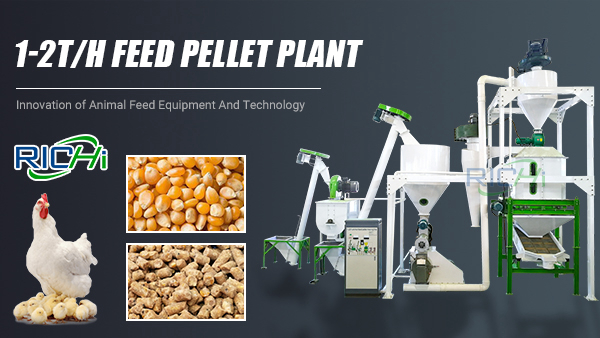
A ruminant feed production line in Indonesia refers to a complete set of feed processing equipment, not a single machine. It integrates crushing, mixing, pelleting, cooling, screening, and packaging into one coordinated system designed specifically for ruminant nutrition requirements.
Depending on feeding strategy, the line can produce:
- Ruminant feed pellets
- Concentrate feed for cattle and goats
- TMR pellets combining roughage and concentrates
- Fiber-rich feed using agricultural residues
The production line can be customized for village-level cooperatives, medium feed mills, or large industrial livestock enterprises.
Raw Materials Suitable for Indonesia
One of Indonesia’s major advantages is its rich and diverse feed resource base. A ruminant feed production line can efficiently process:
- Rice straw and rice husk
- Palm fiber and palm kernel cake
- Corn, corn bran, and corn cob powder
- Cassava pulp and tapioca by-products
- Soybean meal and copra meal
- Grass meal, alfalfa meal, and forage powder
- Mineral premixes and feed additives
By using a flexible ruminant feed processing system, producers can adapt formulas to seasonal availability and regional raw material prices, significantly reducing feed costs.
Process Flow of a Ruminant Feed Production Line
A modern ruminant feed production line in Indonesia follows a standardized process to ensure stable feed quality and high production efficiency.
1. Raw Material Receiving and Cleaning
Raw materials are collected and stored before entering the production line. Cleaning equipment such as vibrating screens and magnetic separators remove stones, metal, and impurities, protecting downstream ruminant feed machines.
2. Crushing and Fiber Processing
Hammer mills and fiber crushers reduce grains and roughage materials to suitable particle sizes. Proper crushing improves mixing uniformity and pellet durability while maintaining fiber structure essential for ruminant digestion.
3. Batching and Mixing
Automatic batching systems accurately weigh each ingredient according to the feed formula. High-efficiency mixers ensure even distribution of roughage, energy sources, protein meals, minerals, and vitamins.
4. Pelleting
Pelleting is the core step of the ruminant feed production line. The ruminant feed pellet machine compresses mixed materials into durable pellets that reduce feed waste, improve palatability, and simplify storage and transportation. Pellet diameter and hardness can be adjusted for cattle, dairy cows, goats, or sheep.
5. Cooling and Crumbling (Optional)
Fresh pellets are hot and moist after pelleting. Counterflow coolers reduce temperature and moisture, improving pellet strength and shelf life. For young animals, pellets can be crumbled into smaller sizes.
6. Screening and Packaging
Finished feed is screened to remove fines and then automatically weighed and packed, completing the ruminant feed manufacturing process.
Key Advantages of a Ruminant Feed Production Line in Indonesia
Investing in a professional ruminant feed production line offers multiple benefits:
Efficient Use of Local Resources
The system enables full utilization of Indonesia’s abundant agricultural by-products, turning low-value residues into high-quality ruminant feed.
Improved Feed Efficiency
Pelleted or TMR feed improves intake consistency, reduces selective feeding, and enhances feed conversion efficiency.
Stable and Consistent Quality
Automated batching and controlled pelleting ensure uniform nutrition in every batch of ruminant feed.
Scalable Production Capacity
From small-scale cooperative feed mills to large industrial plants, production capacity can be customized to match investment scale and market demand.
Reduced Labor and Operating Costs
Automatic ruminant feed production lines reduce manual handling, improve safety, and lower long-term operating costs.
Equipment Configuration of a Ruminant Feed Production Line
A complete ruminant feed production line in Indonesia typically includes:
- Raw material cleaning system
- Hammer mill or fiber crusher
- Automatic batching and mixing system
- Ruminant feed pellet machine
- Counterflow cooler
- Crumbler (optional)
- Vibrating screen
- Automatic packing system
Equipment configuration and plant layout can be customized based on raw material characteristics, site conditions, and production targets.
(click to find out more: https://pelletisingmachine.com/goat-feed-pellet-making-machine/)
Automation and Control Systems
Modern ruminant feed production lines increasingly adopt PLC control systems, enabling:
- Centralized operation and monitoring
- Accurate formula management
- Reduced human error
- Stable and repeatable production performance
Automation is especially valuable for medium and large ruminant feed manufacturing plants in Indonesia, where consistent quality and efficiency are critical.
Application Scenarios in Indonesia
Ruminant feed production lines are widely used in:
- Cattle and dairy farms
- Goat and sheep breeding bases
- Agricultural cooperatives
- Commercial ruminant feed mills
- Integrated farming and feed processing projects
On-site feed production allows farmers and enterprises to gain better control over feed quality, cost, and supply stability.
How to Choose the Right Ruminant Feed Production Line in Indonesia
When selecting a ruminant feed production line, consider the following factors:
- Target animals (beef cattle, dairy cows, goats, sheep)
- Availability and moisture level of local raw materials
- Required production capacity and future expansion plans
- Pellet size and fiber content requirements
- Equipment durability and after-sales technical support
A reliable ruminant feed production line in Indonesia should balance performance, adaptability, and long-term operational stability.
Future Outlook for Ruminant Feed Production in Indonesia
As Indonesia continues to modernize its livestock industry, demand for standardized and nutritionally balanced ruminant feed will grow steadily. Advanced ruminant feed production lines will play a key role in:
- Improving livestock productivity and farmer income
- Reducing dependence on imported feed
- Promoting sustainable use of agricultural by-products
- Supporting national food security and rural development
Investment in modern ruminant feed manufacturing equipment aligns strongly with Indonesia’s long-term agricultural strategy.
Conclusion
A professional ruminant feed production line in Indonesia is the backbone of efficient, scalable, and cost-effective ruminant feeding. By integrating crushing, mixing, pelleting, cooling, and packaging into a single automated system, these production lines enable producers to fully utilize local feed resources while delivering consistent, high-quality feed. For cattle, dairy, goat, and sheep producers across Indonesia, choosing the right ruminant feed production line is a decisive step toward sustainable growth and long-term success.